
Power from the Sun

I’ve long wanted to power our house with a solar system but because we’ve been so serious about energy conservation, our light bill is low. Our friends think our house is like an unlit cave. going so far as to ask if we have moved out due to the lack of a flicker of illumination from the outside at night. I wanted solar for environmental reasons, but the math just didn’t work out – payback periods, depending on the size of the system, were eight years or more. And we are not young people.
But recently, we decided to do it. There were a few factors – the escalating heat, the volatility in oil prices due to the Iran war, Hurricane Melissa last year, Hurricane Beryl the year before that, the islandwide power cut in June 2026 from Jamaica’s main utility provider, the Jamaica Public Service Company, or JPS, and perhaps most importantly, a literary prize which delivered an unexpected financial windfall.
The basics: I live with my husband Fred in a 1600 sq. ft. three-bedroom cottage with a peaked standing seam aluminum roof. Lots of space for solar panels and a good line of sight to the sun. We’re both retired, so mostly at home. The main rooms are air conditioned, but until the installation of the solar system, we hardly used the ACs due to the cost. We sweltered in the summer months – harder to deal with as we aged. We requested solar system quotes from three companies – one did not send, one sent a very young intern who was not able to answer our questions, and the third was from Enerbiz, who we contracted.
Truthfully, I was apprehensive. It was a lot of money to spend – suppose it did not deliver the abundant power, freedom from JPS, and the cool days and nights we both wanted? We had much history with unreliable and inexpert contractors of many kinds, and we expected delays, broken promises and frustration. I don’t want to sound too much like a social media influencer here, but we cannot recommend Enerbiz highly enough. Their principal officer, Chris Foster, was patient with our questions, reliable, communicative, able to solve problems. He inspired confidence and his team was professional and pleasant. Enerbiz provided a quote within a week, said work would start in two weeks (it did) and take two weeks to do two houses – my sister was also solarizing her house, and she lives in the same complex. The work was completed in two weeks and three days, due to various pre-existing complexities, all of which were explained to us as they appeared. The cost – I know you are waiting for this part! – was US$17,500.00 for twelve 625 watt solar panels, a twelve kW inverter and three 10 kW lithium batteries, labour and miscellaneous. Enerbiz worked with us to size the system for our desires as opposed to what our prior JPS bill consumption showed.
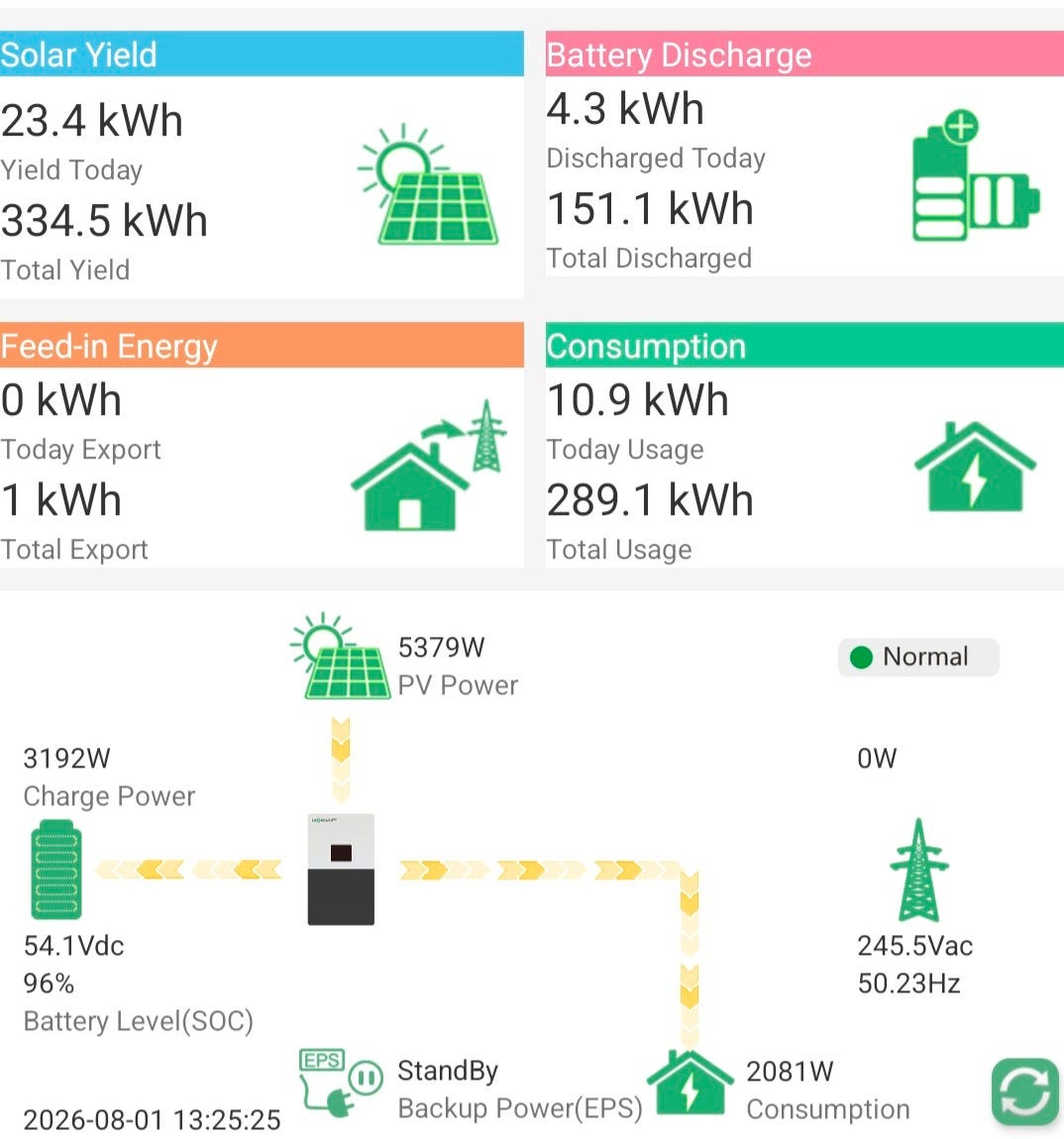
I was away when the system was commissioned. Fred was at home and he learned about the app which we downloaded to our phones, showing how we were using the power generated by the sun. It seemed an incredible thing – the little pictures in my phone of panel, inverter, house and JPS, the arrows flowing from panel to inverter to the house when the sun shone brightly and reversing themselves when it was night. While away, I imagined an unconstrained abundance of electricity.
The reality is not quite like that. The capacity to generate and store electricity is limited by the size of the system we bought and the amount of sunshine on any given day. And I have found myself liking that – I can see how much power the panels are delivering and how much we are consuming in real time. I can even track the use of different appliances as they are turned on or off. When JPS was supplying the power, it seemed out of our hands – all we could do was conserve as much as possible and await the next bill. The solar system allows us to get the best out of the panels – there is no need for the house to be a hot, dark cave. Perhaps we will feel we bought too much energy if temperatures go down later in the year, but for now it feels like an excellent hedge against the heat that is already here and forecast to be worse next year due to the developing El Nino.
People have asked:
1. Won’t a hurricane take the panels off? They are rated for a Category 3 hurricane, so yes, if we do get a direct hit from a stronger storm we could lose both roof and panels. For now, they are insured – I say for now, because as we all know, insurance premiums are increasing along with the temperature. I asked Chris if anyone had ever asked him to remove the panels when a storm threatened and he said no. Where to store them in any case, in the event of a Cat 4 or Cat 5 storm, given the level of destruction that will occur. Our solar system is not a magic shield against catastrophe.
2. Aren’t you worried about the materials used to make the panels? Sure. I long for a day when all industrial materials are manufactured in a closed loop system with very little mining of virgin materials. I believe this will happen as solar power expands.
3. How long will the batteries and panels last? In general, batteries used correctly will last 10-15 years and the panels 25-30. If we do have to replace any aspect of our system, I expect the costs to fall and efficiency of the various components to rise.
I’m writing this on Emancipation Day. We’re at home, the temperature inside was 88.5° F (29.7° degrees C) before we turned on the AC and now it’s comfortable at 80°F (26.7°C). We have a 30,000 BTU inverter AC going, along with the fridge and two fans, and we’re cool inside. I feel in control of the power we generate and use, and we are learning how to operate the various appliances in an optimal way. Fred says we are balancing the panel production, the charging of the batteries and what we are consuming at the same time.
It’s made us mindful, in other words. And that is an excellent place to start, when it comes to individual impact on the planet’s fragile and threatened systems.
I got a much smaller system than yours (8 panels, 1 battery) so if using the air conditioner at night, I set it to come on and go off for an hour at a time at intervals throughout the night.
I have the same app and was able to see my battery status from Trinidad and run my air conditioner for four hours every day for the cats in my bedroom while I was away for a week. I just love that technology!
My JPS bill is now $450/mo, which is the standard customer charge less the early payment bonus. My solar system cost J$1M including the 12,000 BTU AC unit.
I too have been wanting to make this investment but the cost is prohibitive if you are a senior on fixed income. It benefits the country so government should subsidize but I’m not holding my breath
Thanks for sharing the details