
On Blue Lagoon (again)

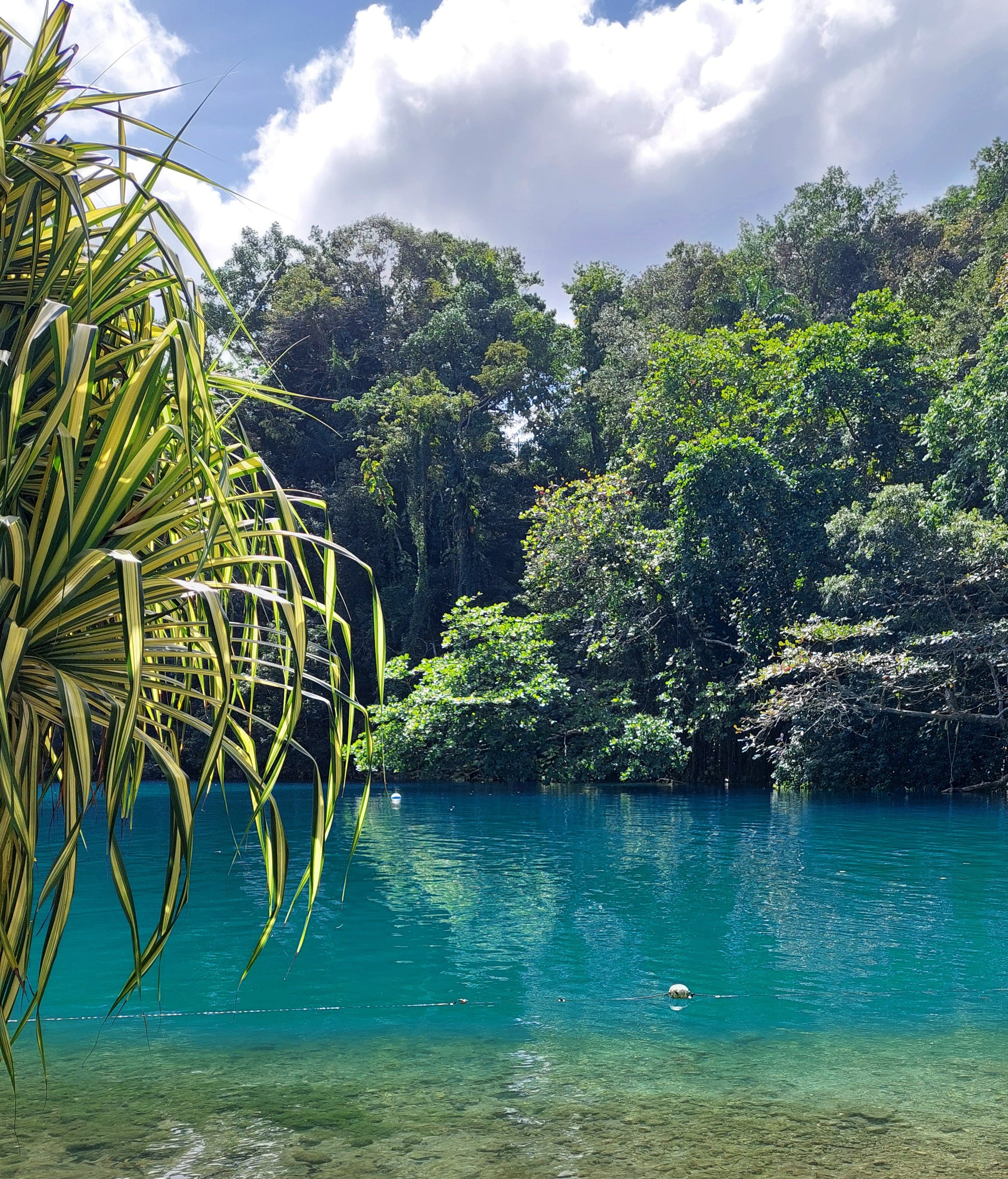
Two days ago, there was a story published in the Jamaica Observer about Blue Lagoon (formerly Blue Hole) in Portland. The gist of the article and a video which seems to have sparked it was that despite earlier media reports, there are no public access barriers at Blue Lagoon. The Observer article implied therefore that the fuss about access was untrue. Absolutely not true!
I’ve written a lot about Blue Lagoon over the years and I’m not sure what new there is to say. But perhaps a recap would be helpful.
Blue Lagoon is a collapsed limestone sinkhole close to Zion Hill, San San Bay and Pellew Island in Portland.
(Sidebar: The Portland Municipal Corporation’s website states that it is ‘the crater of an extinct volcano, it periodically bubbles gently with an accompanying temperature rise, giving evidence of fire far below the surface.’ Sigh. None of this is accurate.)
The Lagoon is open to the sea and partly fed by freshwater streams both over land and underwater. It has steep, verdant sides, mostly still forested, a constructed beach built in 2011 by a nearby hotel. The land surrounding the lagoon has been privately owned since the 1950s. It is the Lagoon’s water that is the star attraction – a clear, dark blue ranging from teal to azure to indigo, depending on the weather. Access is only possible by sea or via a parochial road that leads down to the lagoon, with privately owned land on either side.
There have been many efforts to protect this beautiful place, including preservation notices/orders (1958, 1968 and 2018) and a draft Preservation Scheme (2011). In 2018, it was declared a national monument under the Jamaica National Heritage Trust (JNHT) Act, but the shoreline boundary did not include the adjacent lands. It was closed in August 2022 by the Portland Municipal Corporation due to reported impacts to environmental health, and it is during that period that access was denied to all, at least in theory. Blue Lagoon is currently the subject of legal action filed by the Jamaica Beach Birthright Environmental Movement (JABBEM) to secure the right of access for local people. The court case begins on 19 June 2026.
It is currently being managed by the Jamaica National Heritage Trust (JNHT) and when I last visited in early 2025 there was no restriction to access, but I was disturbed by the lack of attention to aesthetics – there were huge signs, many rough pathways, vending, lines of life vests drying. I thought then that this beauty spot needed a much more subtle approach to its management, to let the beauty and peacefulness of the site shine through. I know, though, that many of us would prefer this and other natural settings to be venues for entertainment and opportunities for income generation.
The management of the Lagoon must also be considered in the context of the upscale villas that now line that parochial road. On one side of the road, large, luxurious villas, their front steps in the sea. On the other side, a steep hill, mostly still covered in pothos vines, but with an area cleared for, I gather, a pickleball court – I am not fully up on this new-ish sport. When I was a teenager, there were some houses on this road already, less ostentatious for sure, but still, there were crab migrations and a fishing beach and there were places you could stop and look out to the Caribbean Sea without being a villa guest.
I no longer know who owns the land around Blue Lagoon. I imagine a private landowner, perhaps one of the people who owns a nearby villa, has leased it to the JNHT – I’d be happy to be informed on this point. But this is where we went wrong – way back in 1958, when the beauty of the place was enough to warrant a preservation notice, but not enough to stop it being sold to private interests. This should never have happened, the land around Blue Lagoon should have been declared a public commons and maintained as the gorgeous place it is, where all can go to picnic, swim (if you are a strong swimmer, the sides are steep and drop off quickly) and enjoy the sheer gift of Blue Lagoon.
I have never been to Dean’s Blue Hole in the Bahamas and can’t find a royalty free picture to share with you, but when I have watched the free diving competitions that take place there, I’m struck by the minimal tourism infrastructure. Trip Advisor reviews say how it was a long drive to a track but that it was worth it. A few posts complain about garbage, the scourge of our plastic era. But apparently Bahamians and their visitors are fine with a place that is merely beautiful and I wish we would be too.
Yes, I do remember visiting Blue Hole when I first returned to Jamaica in the mid 70's. Stunningly beautiful and so serene. Why does every tourist attraction have to be loud? There is value in just being with nature, naturally, without fanfare and hoopla. And yes we all should be able to enjoy.
Always appreciate your input an clarity. I have such gorgeous memories of being a teenager there.